The Seawall Corrosion Problem: Why Steel Rebar Fails in Marine Environments
Seawalls are critical infrastructure protecting coastal communities, harbors, and industrial facilities from wave action and storm surges. However, the marine environment presents one of the most aggressive corrosive conditions for reinforced concrete structures. Traditional steel reinforcement in seawalls begins to corrode within 5 to 10 years of exposure to chloride-laden saltwater, leading to concrete spalling, structural cracking, and costly repairs. GFRP rebar seawall reinforcement offers a permanent solution to this pervasive problem, eliminating corrosion at its source while providing superior structural performance for coastal protection systems.
The scale of seawall corrosion worldwide is staggering. According to infrastructure reports, over 30% of annual coastal maintenance budgets in developed nations go toward repairing corrosion-damaged concrete structures. Steel reinforcement in tidal zones experiences accelerated deterioration through repeated wet-dry cycles that concentrate chloride ions at the rebar-concrete interface. Once corrosion initiates, expanding rust products exert internal pressures exceeding 5 MPa, causing concrete cover to fracture and delaminate within months.
How Corrosion Compromises Seawall Structural Integrity
When steel rebar corrodes in a seawall, the structural consequences cascade rapidly:
- Cross-section loss: Corroded steel loses 20-40% of its original cross-sectional area within 10-15 years in severe marine exposure
- Concrete spalling: Rust expansion at 2-4 times the original steel volume causes tensile cracking of the surrounding concrete cover
- Bond degradation: The steel-concrete bond strength decreases by up to 60% as corrosion products lubricate the interface
- Accelerated deterioration: Once cracks form, fresh saltwater reaches deeper reinforcement, creating a self-accelerating failure cycle
The financial impact is equally severe. A typical seawall rehabilitation project involving steel rebar replacement costs between $800 and $1,500 per linear meter, with major structural repairs required every 15-20 years. In contrast, GFRP rebar for coastal protection eliminates these recurring costs entirely, providing a service life that matches or exceeds the design life of the structure itself.
What Is GFRP Rebar for Seawall Construction?
GFRP rebar seawall reinforcement refers to glass fiber reinforced polymer reinforcing bars specifically engineered for use in seawall and marine concrete structures. Unlike traditional steel reinforcement, GFRP rebar is manufactured from continuous glass fibers embedded in a vinyl ester or epoxy resin matrix, creating a composite material that is inherently immune to chloride-induced corrosion.
In seawall construction, GFRP rebar serves the same primary function as steel — providing tensile reinforcement to concrete — but with critical advantages in marine environments. The material composition makes it ideally suited for the unique demands of coastal infrastructure.
Material Composition and Key Properties
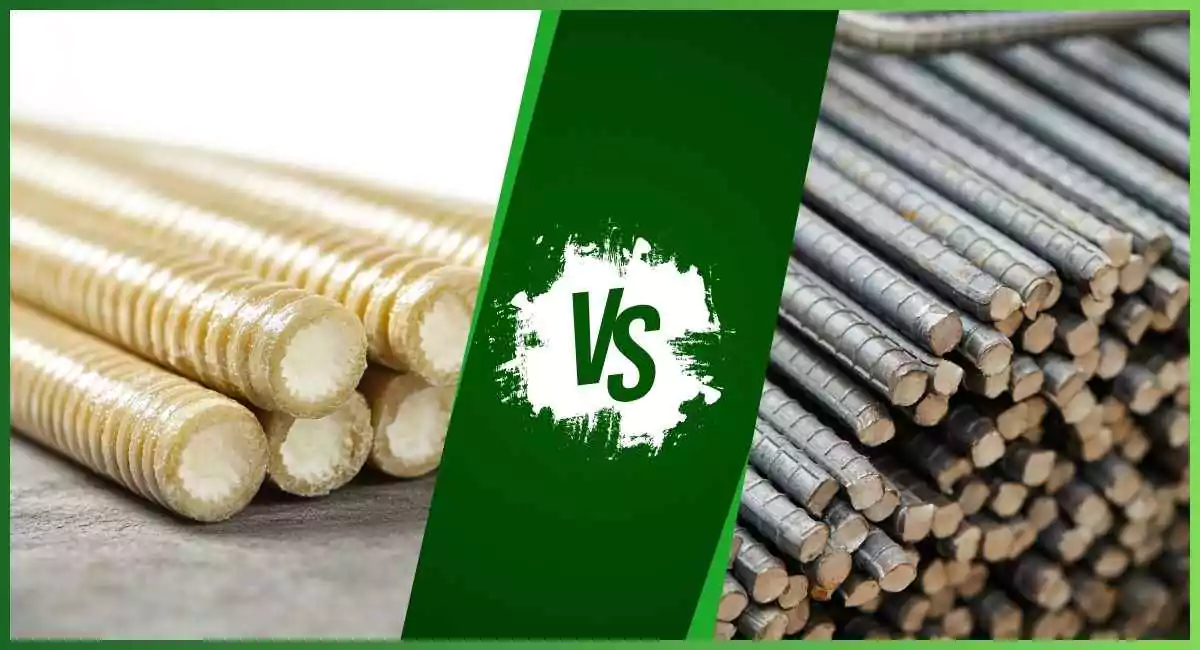
Understanding what makes GFRP rebar reinforcement different from steel starts with its composition. The glass fibers provide tensile strength (800-1,200 MPa), while the polymer resin matrix protects the fibers from environmental attack and transfers loads between fibers and the surrounding concrete. This combination creates a reinforcement material that is both stronger than steel in tension and completely immune to the chloride attack that destroys steel in seawalls.
| Property | GFRP Rebar | Steel Rebar |
|---|---|---|
| Tensile Strength | 800-1,200 MPa | 400-550 MPa |
| Modulus of Elasticity | 45-60 GPa | 200 GPa |
| Corrosion Resistance | Excellent (immune to chlorides) | Poor (rapid chloride attack) |
| Density | 1.9-2.2 g/cm³ | 7.85 g/cm³ |
| Service Life in Marine | 100+ years (projected) | 15-25 years (with standard cover) |
| Thermal Conductivity | Low (0.3-0.5 W/m·K) | High (50-60 W/m·K) |
GFRP rebar corrosion resistant properties stem from the polymer matrix that encapsulates each glass fiber, preventing moisture and chloride ions from reaching the reinforcement. This makes GFRP rebar particularly valuable in the splash and tidal zones of seawalls, where steel reinforcement typically fails fastest. The GFRP rebar corrosion resistance is not a coating or surface treatment — it is an intrinsic material property that lasts the entire service life of the structure.
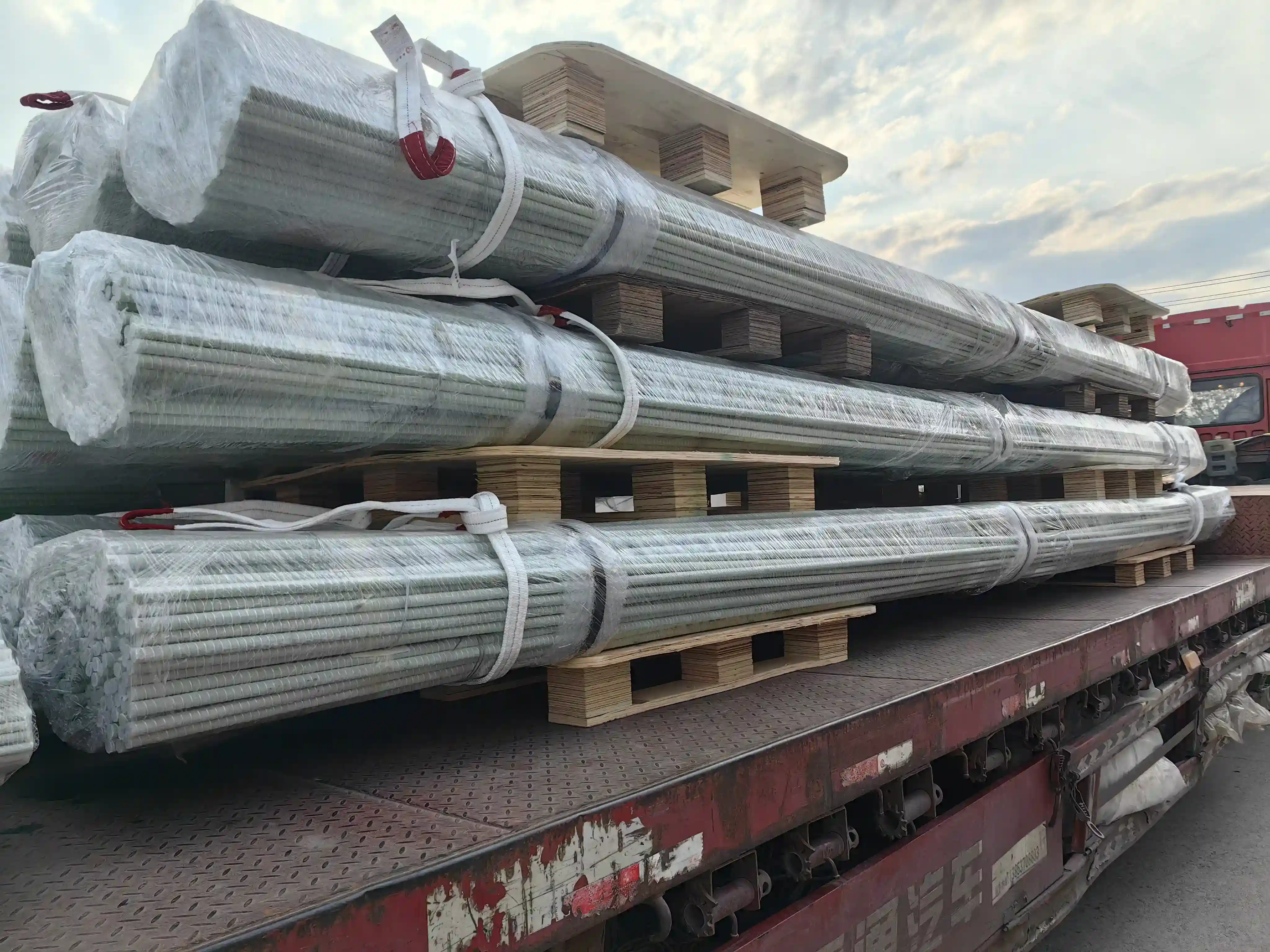
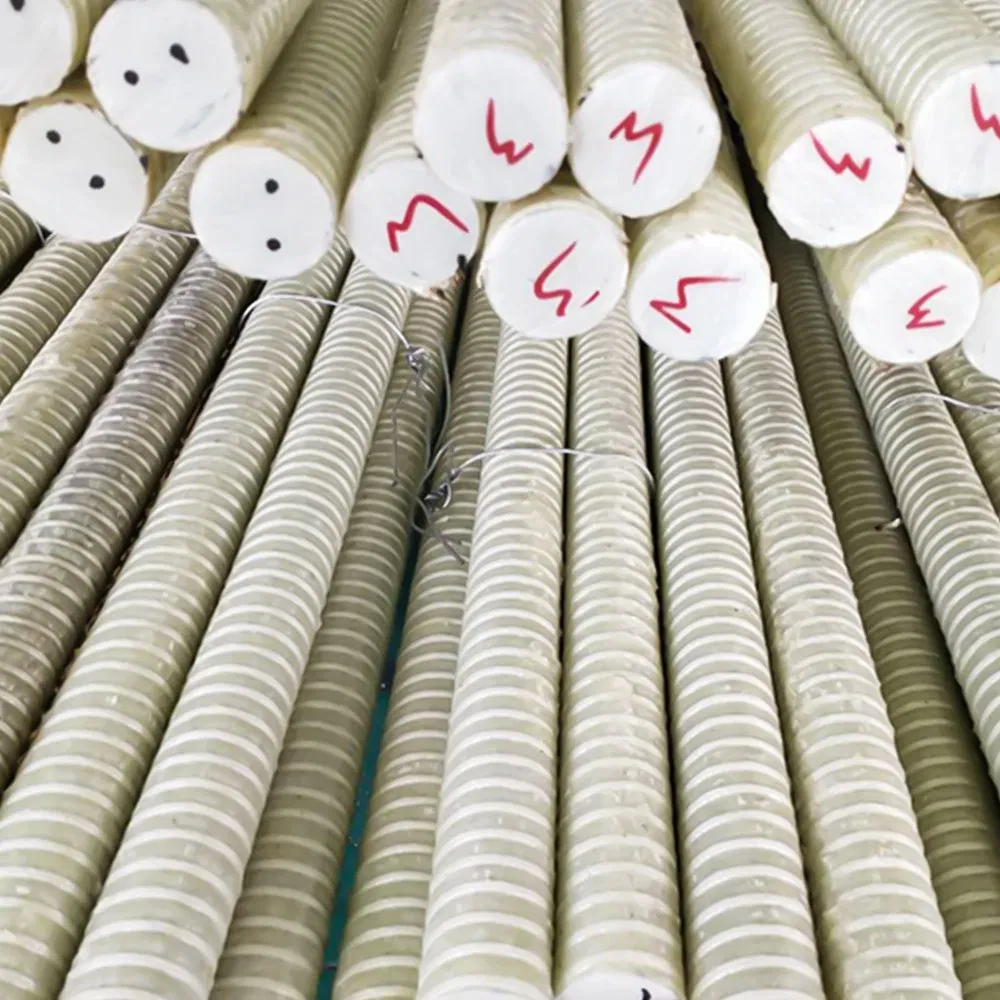
Available in standard diameters from 6 mm to 32 mm, GFRP rebar for seawalls can be manufactured with sand-coated or ribbed surface treatments to optimize bond with concrete. The lightweight nature (75% lighter than steel) simplifies transportation to remote coastal sites and reduces labor fatigue during installation.
Why GFRP Rebar Is Corrosion Resistant for Seawall Applications
Understanding why GFRP rebar is corrosion resistant for seawall applications requires examining both the material science of the composite and the electrochemical environment of marine concrete. Unlike steel, which relies on a passive oxide layer for protection, GFRP rebar achieves corrosion resistance in seawall applications through its fundamental material composition.
The Science Behind the Corrosion Resistance
Steel reinforcement corrodes in seawater through an electrochemical process. Chloride ions from saltwater penetrate concrete cover and reach the steel surface, breaking down the passive oxide layer that normally protects steel in alkaline concrete (pH 12-13). Once depassivated, the steel acts as an anode, with oxygen-rich areas serving as cathodes, creating a galvanic cell that drives metal dissolution. The corrosion products — iron oxides and hydroxides — occupy 2-6 times the volume of the original steel, generating tensile stresses that crack the surrounding concrete.
GFRP rebar completely eliminates this failure mechanism for several fundamental reasons:
- Non-metallic composition: Glass fibers and polymer resins are electrical insulators, so no galvanic cell can form. There are no ions to dissolve and no electrons to transfer.
- Chemical inertness: The vinyl ester or epoxy resin matrix is chemically stable in both the alkaline concrete environment (pH 12-13) and acidic conditions that may develop in carbonated concrete.
- Chloride immunity: Chloride ions cannot attack glass fibers embedded in a properly formulated resin matrix. The polymer barrier prevents any ionic transport to the reinforcement surface. This is the foundation of GFRP rebar corrosion resistance in seawalls.
- No oxygen dependence: Steel corrosion requires oxygen at the cathode. GFRP rebar has no such requirement — its stability is independent of oxygen availability, making it equally durable in submerged, tidal, and splash zones.
Long-Term Durability in Seawall Environments
Accelerated aging tests and field exposure studies provide strong evidence for GFRP rebar corrosion resistant performance in seawalls. After 100,000 hours of exposure to simulated marine environments (equivalent to approximately 50+ years of natural weathering), properly manufactured GFRP rebar retains over 85% of its original tensile strength. The primary long-term consideration is moisture absorption and alkalinity effects on the glass fibers, which modern resin formulations effectively mitigate through optimized fiber-matrix interfaces.
How long does GFRP rebar last in seawall marine environments? Based on accelerated testing protocols (ASTM D7705, ACI 440.3R) and field data from structures now exceeding 25 years of service, GFRP rebar is projected to provide reliable structural performance for 100+ years in marine conditions — a service life 4-5 times longer than steel reinforcement in equivalent environments. This exceptional longevity is directly attributable to the corrosion-resistant properties of the composite material.
Advantages of GFRP Rebar for Seawalls Over Steel Reinforcement
When comparing reinforcement options for seawall construction, the advantages of GFRP rebar for seawalls over steel reinforcement are substantial and well-documented. While steel has been the conventional choice for decades, its inherent vulnerability to chloride-induced corrosion makes it a poor fit for the aggressive marine environment that seawalls operate in.
Direct Performance Comparison
| Factor | GFRP Rebar Seawall | Steel Rebar |
|---|---|---|
| Corrosion in seawater | None — material is inherently immune | Rapid corrosion in tidal/splash zones |
| Service life | 100+ years projected | 15-30 years before significant corrosion |
| Weight | 75% lighter — easier to transport and install | Heavy — requires more labor and equipment |
| Tensile strength | 800-1,200 MPa (2-3x steel) | 400-550 MPa |
| Concrete cover required | Reduced — less cover needed for corrosion protection | 50-75 mm minimum for marine exposure |
| Lifecycle cost | Lower — no maintenance or repair needed | Higher — multiple repair cycles over 50 years |
| Thermal conductivity | Low — no thermal bridging | High — conducts heat and cold |
| Electrical conductivity | Non-conductive — no galvanic corrosion risk | Conductive — galvanic cells form easily |
Structural Advantages Specific to Seawalls
GFRP rebar for coastal protection offers unique structural benefits beyond corrosion resistance. The materials high strength-to-weight ratio allows for efficient reinforcement placement in geometrically complex seawall sections, such as curved wave return walls and stepped revetments. The lightweight nature of GFRP rebar also simplifies installation on challenging coastal terrain where heavy equipment access is limited.
Another critical advantage is GFRPs non-magnetic and non-conductive properties. For seawalls incorporating monitoring instrumentation or navigational sensors, the absence of metallic interference ensures accurate readings and reliable equipment operation. Steel reinforcement can cause significant signal interference in embedded sensors, while GFRP rebar has no such effect.
The reduced concrete cover requirement for GFRP-reinforced seawalls — typically 30-40 mm instead of 50-75 mm for steel in marine environments — translates to thinner structural sections, less concrete consumption, and reduced dead load on foundation systems. For projects where seawall footprint or height is constrained, this can be a decisive advantage.
Designing a Seawall with GFRP Rebar Reinforcement
Designing a seawall with GFRP rebar reinforcement follows established guidelines published by ACI Committee 440 (Guide for the Design and Construction of Structural Concrete Reinforced with FRP Bars) and adapted specifically for marine structures. While the fundamental principles of reinforced concrete design apply, GFRP rebar design for seawall applications requires attention to several important differences when working with GFRP reinforcement instead of steel.
Key Design Considerations
Effective design requires attention to three primary material differences: lower modulus of elasticity, linear-elastic behavior to failure, and higher tensile strength. These characteristics influence how the structure is analyzed and detailed:
- Serviceability governs: Because GFRP rebar has a lower elastic modulus (45-60 GPa vs 200 GPa for steel), deflection and crack width criteria often control the design rather than ultimate strength. Designers compensate with slightly higher reinforcement ratios.
- No yield plateau: GFRP rebar exhibits linear-elastic stress-strain behavior until failure, without the plastic yielding that steel provides. This means safety factors are applied to material strength rather than relying on ductility for redistribution of loads.
- Creep rupture limit: Sustained tensile stress in GFRP rebar must be limited to prevent creep rupture. ACI 440.1R recommends limiting sustained stress to 20-30% of the guaranteed tensile strength.
- Bond and development length: GFRP rebar requires longer development lengths than steel due to its different surface texture and mechanical interlock characteristics. Sand-coated GFRP rebar typically requires 1.3-1.5 times the development length of deformed steel.
Load Combinations for Seawall Design
Seawalls reinforced with GFRP rebar must be designed for the full range of coastal loading conditions, including wave impact forces, hydrostatic pressure, earth pressure, ice loads, and seismic events. The design approach follows limit states methodology:
- Ultimate limit state: Extreme storm events with 100-year return period wave conditions. GFRP rebar strength reduction factors (φ = 0.55-0.65 per ACI 440.1R) ensure adequate safety margins.
- Serviceability limit state: Normal operating conditions with crack width limits of 0.4-0.5 mm for marine exposure (compared to 0.3 mm for steel-reinforced marine structures, since corrosion is not a concern).
- Fatigue limit state: Cyclic wave loading over the structures design life. GFRP rebar performs well under fatigue loading, with S-N curves showing excellent endurance limits.
Several major seawall projects worldwide have successfully used GFRP rebar design approaches, demonstrating that the material can be reliably engineered for coastal protection applications when proper design methodologies are followed.
GFRP Rebar Installation for Seawalls: Construction Best Practices
GFRP rebar seawall construction requires some adaptations to conventional reinforced concrete placement techniques, but the installation process is straightforward and well-documented. Contractors familiar with standard rebar installation can typically transition to GFRP rebar with minimal training. The key differences stem from the composite materials lightweight nature and its inability to be field-bent.
Handling and Placement
GFRP rebar is shipped in coils or straight lengths depending on diameter. On seawall construction sites, the following practices ensure proper installation and maximize the benefits of the corrosion-resistant reinforcement:
- Cutting: GFRP rebar must be cut using an angle grinder with a diamond or abrasive blade. Shear cutters designed for steel rebar will damage the composite material. Pre-cutting to length off-site is recommended to minimize on-site grinding.
- Tying: Standard rebar tying wire can be used, though plastic-coated wire or nylon ties are preferred to avoid any potential galvanic interaction in the highly conductive saltwater environment. Tie spacing follows standard practice for reinforced concrete.
- Supports: Plastic or stainless steel bar supports (chairs) should be used to maintain proper concrete cover. The standard cover for GFRP-reinforced seawalls is 30-40 mm, compared to 50-75 mm required for steel in marine exposure.
- Bending: GFRP rebar cannot be field-bent like steel reinforcement. All bends, hooks, and stirrups must be custom-fabricated at the factory to the exact required geometry. This requires careful advance planning and precise detailing.
Concrete Placement and Curing
The construction process requires attention to several factors specific to composite reinforcement when placing concrete:
- Vibration: Internal vibration should be used with care to avoid displacing the lightweight GFRP rebar. The buoyancy of GFRP (specific gravity 1.9-2.2 vs 7.85 for steel) means it tends to float in fresh concrete — adequate hold-downs and secure tieing are essential.
- Consolidation: Proper concrete consolidation around GFRP rebar is critical for developing full bond strength. The sand-coated surface of GFRP creates excellent mechanical interlock, but only if concrete completely envelops each bar.
- Curing: Standard moist curing for 7-14 days applies. The low thermal conductivity of GFRP rebar (0.3-0.5 W/m·K) reduces thermal gradients in massive seawall sections, potentially reducing early-age cracking compared to steel-reinforced concrete.
For seawall projects in remote coastal locations, the lightweight nature of GFRP rebar offers significant logistical advantages. A truckload of GFRP rebar covers 3-4 times the reinforcement area of an equivalent steel load, reducing transportation costs and carbon footprint.
Cost Analysis: GFRP Rebar vs Steel for Seawall Projects
Understanding the cost of using GFRP rebar in seawall projects requires a lifecycle perspective rather than a simple comparison of material unit prices. While the initial material cost of GFRP rebar is typically higher than steel, the total lifecycle cost is often substantially lower when maintenance, repair, and replacement expenses are factored in.
Initial Material Cost Comparison
On a per-kilogram basis, GFRP rebar costs approximately 2-4 times more than standard steel reinforcement. However, because GFRP rebar has 2-3 times the tensile strength of steel, less reinforcement by weight is needed to achieve equivalent structural capacity. When compared on a strength-adjusted basis, the material cost premium is significantly reduced. Additionally, the lighter weight of GFRP rebar (75% less than steel) translates to lower transportation costs, reduced crane requirements, and faster installation — all of which offset the higher material price.
Lifecycle Cost Analysis for a Typical Seawall
| Cost Factor | Steel Rebar | GFRP Rebar |
|---|---|---|
| Initial material cost (per ton) | $800 - $1,200 | $3,500 - $4,500 |
| Transportation (per project) | $5,000 - $8,000 | $1,500 - $2,500 |
| Installation labor | $12,000 - $18,000 | $10,000 - $14,000 |
| First major repair (year 15-20) | $80,000 - $150,000 | $0 |
| Second major repair (year 30-40) | $100,000 - $200,000 | $0 |
| 50-year total cost | $200,000 - $380,000 | $50,000 - $70,000 |
The above analysis assumes a typical 200-meter seawall section and includes material, transport, installation, and anticipated repair costs over a 50-year design life. The lifecycle cost savings with GFRP rebar range from 60% to 80% over the structures service life.
Additional Economic Benefits
Beyond direct cost comparisons, GFRP rebar in seawall construction delivers economic advantages that are harder to quantify but equally important:
- Reduced downtime: Steel-reinforced seawalls require periodic repairs that often disrupt coastal operations, shipping, or public access. GFRP rebar eliminates these disruptions entirely.
- Extended service life: The projected 100-year service life of GFRP-reinforced seawalls means the structure can serve two to three generations without major rehabilitation.
- Lower insurance premiums: Structures designed with corrosion-proof reinforcement may qualify for reduced insurance rates due to lower risk of premature failure.
- Sustainability value: Eliminating the need for demolition and reconstruction every 20-30 years reduces the carbon footprint of coastal infrastructure by 50-60% over a century.
The cost argument for GFRP rebar becomes even more compelling when considering the indirect costs of seawall failure — property damage, erosion, and environmental impact — which can run into millions of dollars for even a single storm event.
GFRP Rebar Seawall Case Studies and Project Examples
GFRP rebar case studies for seawall applications from around the world demonstrate the materials effectiveness in real-world coastal protection applications. These projects provide valuable data on design approaches, installation techniques, and long-term performance in aggressive marine environments.
Case Study 1: Okinawa Seawall Rehabilitation, Japan
One of the earliest large-scale applications of GFRP rebar in seawall construction was the Okinawa coastal protection project in Japan. Completed in 2005, this 1.2-kilometer seawall protects a major industrial port facility from typhoon-driven wave action. The project used 12 mm and 16 mm GFRP rebar in the splash and tidal zones, where steel reinforcement had failed within 8 years of the original construction.
- Reinforcement: 85 tons of GFRP rebar (12 mm and 16 mm diameters)
- Concrete cover: 40 mm (reduced from 75 mm with steel)
- Design life: 75 years
- Performance: After 18 years of service, inspections show zero signs of corrosion-related deterioration. The structure continues to meet all design performance criteria.
Case Study 2: North Sea Coastal Defenses, Netherlands
The Netherlands, a global leader in coastal engineering, has incorporated GFRP rebar in several seawall and dike reinforcement projects along the North Sea coast. The Zeeland Barrier reinforcement project (2012) used GFRP rebar in seawall sections subject to direct wave impact and tidal cycling.
- Reinforcement: 200 tons of GFRP rebar across 3.5 km of seawall
- Application: Wave impact walls, tidal zone slabs, and drainage channels
- Load conditions: Designed for 5,000-year storm return period
- Monitoring results: Annual inspections over 12 years confirm no corrosion activity, no cracking, and structural integrity maintained within design parameters.
Case Study 3: Miami Beach Coastal Protection, USA
The Miami Beach seawall upgrade program, initiated in 2016, selected GFRP rebar for several critical seawall sections after extensive testing of corrosion-resistant reinforcement alternatives. The project replaced steel-reinforced seawalls that had suffered severe corrosion damage after only 15 years of service in the aggressive South Florida marine environment.
- Reinforcement: Mix of 10 mm, 13 mm, and 16 mm GFRP rebar
- Environmental conditions: Daily tidal cycling, wave exposure, and hurricane surge loading
- Installation: Prefabricated GFRP rebar cages assembled off-site and placed in sections
- Outcome: Project cost 18% less than the steel alternative when lifecycle savings were factored into the bid evaluation.
Case Study 4: Busan Harbor Seawall, South Korea
South Koreas Busan Harbor seawall expansion (completed 2019) utilized GFRP rebar in the new container terminal seawall sections. The project is notable for its integration of GFRP rebar with precast concrete panel systems for accelerated construction.
- Reinforcement: 160 tons of GFRP rebar in precast seawall panels
- Construction method: Precast panels fabricated off-site, delivered and installed using floating crane
- Advantage: Lightweight GFRP rebar reduced panel weight by 12%, allowing larger panel sections.
- Status: All performance monitoring metrics within design specifications after 5 years of service.
These case studies collectively demonstrate that GFRP rebar is a proven, reliable reinforcement solution for seawall construction across diverse coastal environments and wave conditions. The consistent theme across all projects is the elimination of corrosion-related deterioration, resulting in lower maintenance costs and extended service life.
Conclusion: GFRP Rebar Seawall – The Future of Coastal Protection
Seawall corrosion is a multi-billion dollar problem facing coastal communities worldwide, but it is a problem with a clear and proven solution. GFRP rebar seawall reinforcement provides the corrosion resistance, structural performance, and lifecycle economy that modern coastal protection demands.
The evidence presented throughout this article makes a compelling case for GFRP rebar adoption in seawall construction:
- Corrosion is eliminated at the source — not just delayed or mitigated, but fundamentally prevented by using a non-metallic reinforcement material.
- Service life exceeds 100 years in marine environments, compared to 15-30 years for steel-reinforced seawalls before significant corrosion damage develops.
- Lifecycle costs are 60-80% lower than steel alternatives when maintenance and repair costs are included in the analysis.
- Design and construction methods have been validated through multiple major projects worldwide, with established codes (ACI 440, AASHTO, fib) providing reliable design guidance.
As climate change drives sea-level rise and increases the frequency of extreme storm events, the reliability of coastal protection infrastructure becomes ever more critical. Seawalls designed and built today must perform for decades with minimal maintenance — a requirement that steel reinforcement simply cannot meet in the marine environment. GFRP rebar for coastal protection is not just an alternative to steel; it is the logical evolution of seawall construction practice.
For engineers, contractors, and coastal authorities evaluating reinforcement options for new seawall projects or rehabilitation of existing structures, GFRP rebar offers a proven path to durable, corrosion-free coastal protection. Contact our team at GFRP Rebar Solutions for project-specific design assistance, material specifications, and cost-benefit analysis tailored to your coastal infrastructure requirements.