Introduction
Fiberglass rebar has emerged as one of the most innovative alternatives to traditional steel reinforcement in modern construction. Made from high-strength glass fibers embedded in a polymer resin matrix, this composite material offers exceptional durability, corrosion resistance, and structural performance. As engineers and contractors increasingly seek solutions for challenging environments — from marine structures to chemical plants — understanding fiberglass rebar properties, applications, and pricing becomes essential for informed procurement decisions.
This comprehensive guide explores everything you need to know about fiberglass rebar: how it is manufactured, how its mechanical properties compare to steel, the standard specifications it must meet, available sizes, typical applications, pricing factors, and installation best practices. Whether you are planning a bridge deck, a seawall, or a concrete foundation in aggressive soil conditions, this article will help you evaluate whether fiberglass rebar is the right choice for your project.
What Is Fiberglass Rebar and How Is It Manufactured?
Fiberglass rebar, also known as GFRP (Glass Fiber Reinforced Polymer) rebar, is a composite reinforcement material manufactured through a continuous pultrusion process. Unlike traditional steel rebar, which is made from molten iron and carbon alloys, fiberglass rebar combines thousands of continuous glass filaments with a thermosetting resin — typically vinyl ester or epoxy — to create a high-strength, corrosion-proof reinforcing bar.
Raw Materials and Composition
The primary raw materials in fiberglass rebar manufacturing include:
- E-glass or S-glass fibers — These provide the tensile strength and represent approximately 65-75% of the final product by volume. E-glass offers excellent electrical and mechanical properties, while S-glass delivers higher strength for specialized applications.
- Vinyl ester or epoxy resin — This thermosetting polymer binds the glass fibers together, protects them from environmental degradation, and transfers loads between fibers. Vinyl ester is preferred for its superior corrosion resistance in alkaline concrete environments.
- Fillers and additives — UV stabilizers, flame retardants, and pigments may be added depending on the intended application requirements.
The Pultrusion Manufacturing Process
The manufacturing of fiberglass rebar follows a precise, continuous pultrusion process:
- Creel station: Hundreds of continuous glass fiber rovings are mounted on creels and fed through tension-controlled guides.
- Resin impregnation: The fibers pass through a resin bath where they are fully saturated with the liquid polymer matrix.
- Pre-forming: The wet fibers are shaped through a series of guides to remove excess resin and arrange fibers in the desired cross-sectional profile.
- Curing die: The shaped composite enters a heated die where the resin cures (hardens) at temperatures between 150-200°C, forming a solid bar.
- Surface treatment: While still partially cured, a helical wrapping or sand coating is applied to create mechanical bond with concrete — similar to the deformations on steel rebar.
- Cooling and cutting: The continuous bar is cooled, then cut to length — typically 6 or 12 meters for standard construction use.
This automated process produces consistent, high-quality fiberglass rebar with precisely controlled fiber alignment and resin content. The result is a reinforcement bar that weighs only one-quarter of steel while offering twice the tensile strength in the longitudinal direction.
Fiberglass Rebar Properties vs Steel Reinforcement
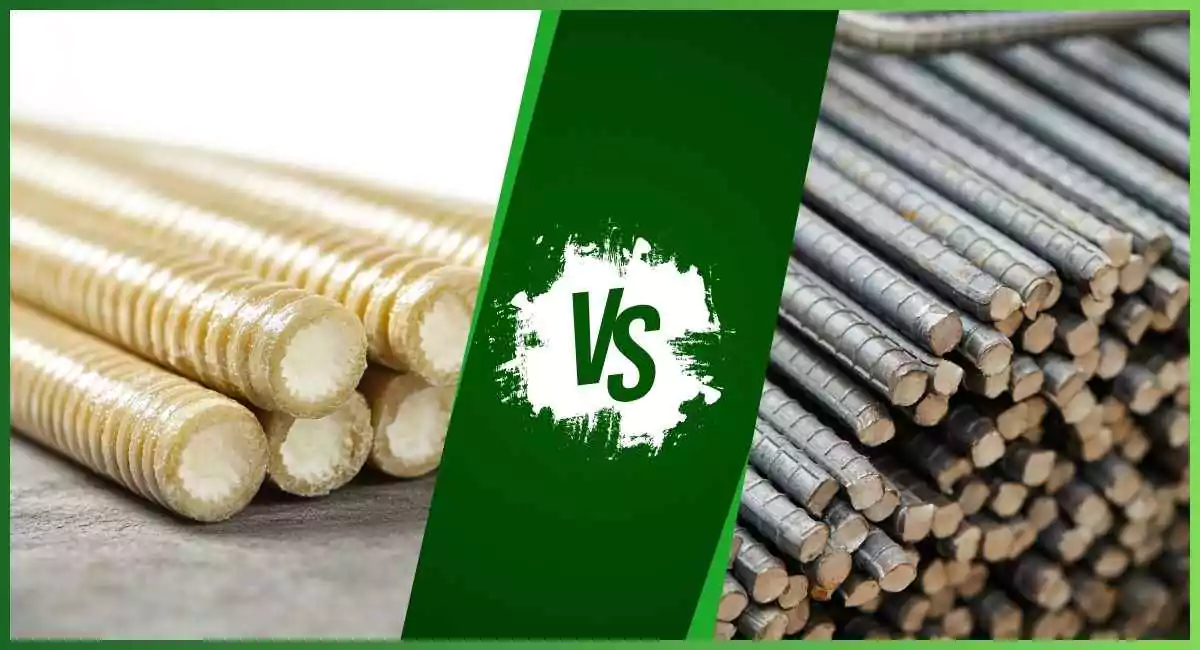
When evaluating fiberglass rebar properties vs steel reinforcement, several key differences emerge that make fiberglass rebar the superior choice in specific applications. Understanding these mechanical and physical property differences is essential for engineers and contractors selecting the right reinforcement material.
Corrosion Resistance: Why Fiberglass Rebar Does Not Rust
The most significant advantage of fiberglass rebar over steel is its complete immunity to corrosion. Steel rebar rusts when chlorides, moisture, and oxygen penetrate concrete and reach the embedded steel. This electrochemical reaction causes the rust to expand up to six times its original volume, creating internal pressure that cracks and spalls the concrete — the primary cause of premature concrete deterioration worldwide.
Fiberglass rebar does not rust because the glass fibers and polymer resin matrix are chemically inert and non-conductive. Saltwater, de-icing chemicals, and acidic environments have no effect on the material. This makes it the preferred reinforcement choice for:
- Marine structures exposed to saltwater spray and tidal zones
- Bridge decks treated with road salt in winter climates
- Seawalls and coastal protection infrastructure
- Chemical processing plants and wastewater treatment facilities
Fiberglass Rebar Tensile Strength
Fiberglass rebar tensile strength is one of its most impressive characteristics. While steel rebar typically has a tensile yield strength of 60,000-75,000 psi (414-517 MPa), fiberglass rebar exhibits ultimate tensile strengths ranging from 100,000 to 150,000 psi (690-1,034 MPa) — approximately two to three times that of standard steel reinforcement.
However, fiberglass rebar behaves differently under load. Steel yields plastically before failure, giving visual warning. Fiberglass rebar is linearly elastic until sudden rupture — it does not yield. This elastic behavior requires different design approaches, which is why design codes like ACI 440.11 have been developed specifically for GFRP reinforcement.
Weight Comparison
Fiberglass rebar weighs approximately 75-80% less than steel rebar of equivalent diameter. A typical 12mm fiberglass rebar weighs about 0.32 kg/m, compared to 0.89 kg/m for steel. This weight advantage translates to:
- Lower transportation costs — ship more material per load
- Easier manual handling — less labor fatigue and injury risk
- Reduced structural dead load — beneficial for lightweight structures
- Simplified installation — no heavy lifting equipment needed for placement
| Property | Fiberglass Rebar | Steel Rebar |
|---|---|---|
| Tensile Strength (MPa) | 690-1,034 | 414-517 |
| Density (g/cm³) | 1.9-2.2 | 7.85 |
| Weight (12mm bar, kg/m) | 0.32 | 0.89 |
| Corrosion Resistance | Excellent | Poor |
| Thermal Conductivity | Low | High |
| Electrical Conductivity | Non-conductive | Conductive |
| Elongation at Break (%) | 1.5-2.5 | 8-14 |
Thermal and Electrical Properties
Fiberglass rebar is non-conductive both thermally and electrically — a significant advantage for certain applications. In MRI facilities, laboratories, and electrical substations, using fiberglass rebar eliminates electromagnetic interference and minimizes heat transfer through concrete elements. Steel rebar, by contrast, conducts both heat and electricity, which can create thermal bridges and electrical hazards in sensitive environments.
Standard Specifications and Certifications for Fiberglass Rebar
To ensure quality, safety, and structural reliability, fiberglass rebar must comply with internationally recognized standards and certifications. Understanding these requirements helps buyers verify that the product they purchase meets minimum performance criteria for construction applications.
ASTM D7957 Standard Specification
ASTM D7957 is the primary standard for solid round glass fiber reinforced polymer (GFRP) bars for concrete reinforcement in North America. It defines the requirements for:
- Tensile properties: Minimum tensile strength, modulus of elasticity, and elongation requirements based on bar diameter.
- Dimensions and tolerances: Acceptable diameter variations, cross-sectional area calculations, and length tolerances.
- Bond characteristics: Requirements for surface deformation patterns that ensure adequate mechanical interlock with concrete.
- Environmental durability: Testing protocols for moisture absorption, alkaline resistance, and freeze-thaw performance.
ACI 440.11 Building Code Requirements
ACI 440.11 provides the design and construction code for structural concrete reinforced with GFRP bars. It covers strength design methods, serviceability requirements, development and splice lengths, and minimum reinforcement ratios. Projects using fiberglass rebar must follow these code provisions to ensure structural safety. Key aspects include:
- Design tensile strength is based on guaranteed values, not mean values
- Shear strength contributions from GFRP reinforcement
- Crack width and deflection control criteria
- Environmental reduction factors for different exposure conditions
International Certifications
Beyond ASTM and ACI standards, quality fiberglass rebar should carry these certifications:
- ICC-ES AC454: Evaluation criteria for GFRP reinforcing bars, recognized by building code officials across the United States.
- CE Marking (EN 13706): European standard for pultruded profiles, required for construction products sold in the European Union.
- ETA (European Technical Assessment): Provides evidence of fitness for purpose for construction products across EU member states.
- ISO 9001: Quality management system certification for the manufacturing facility.
When sourcing fiberglass rebar, always request a copy of the manufacturer test reports and certification documents. Reputable suppliers provide full traceability documentation, including tensile test results, dimensional inspection reports, and material certifications for every production batch.
Available Fiberglass Rebar Sizes for Construction
One of the most common questions engineers and contractors ask is what fiberglass rebar sizes are available for construction projects. Fiberglass rebar is produced in a range of diameters and lengths to match the requirements of various structural applications, from light-duty slabs to heavy infrastructure.
Common Diameters and Standard Lengths
Fiberglass rebar is manufactured in standard metric and imperial sizes that correspond to traditional steel rebar dimensions. The most commonly available diameters include:
| Diameter (mm) | Diameter (inches) | Equivalent Steel Size | Typical Application |
|---|---|---|---|
| 6 mm | #2 (1/4") | 6 mm steel | Light slabs, walls, shotcrete |
| 8 mm | #3 (3/8") | 8 mm steel | Floor slabs, precast elements |
| 10 mm | #4 (1/2") | 10 mm steel | Beams, columns, general reinforcement |
| 12 mm | #5 (5/8") | 12 mm steel | Bridge decks, heavy slabs |
| 16 mm | #6 (3/4") | 16 mm steel | Heavy foundations, retaining walls |
| 20 mm | #7 (7/8") | 20 mm steel | Large structural elements |
| 25 mm | #8 (1") | 25 mm steel | Massive structures, bridge girders |
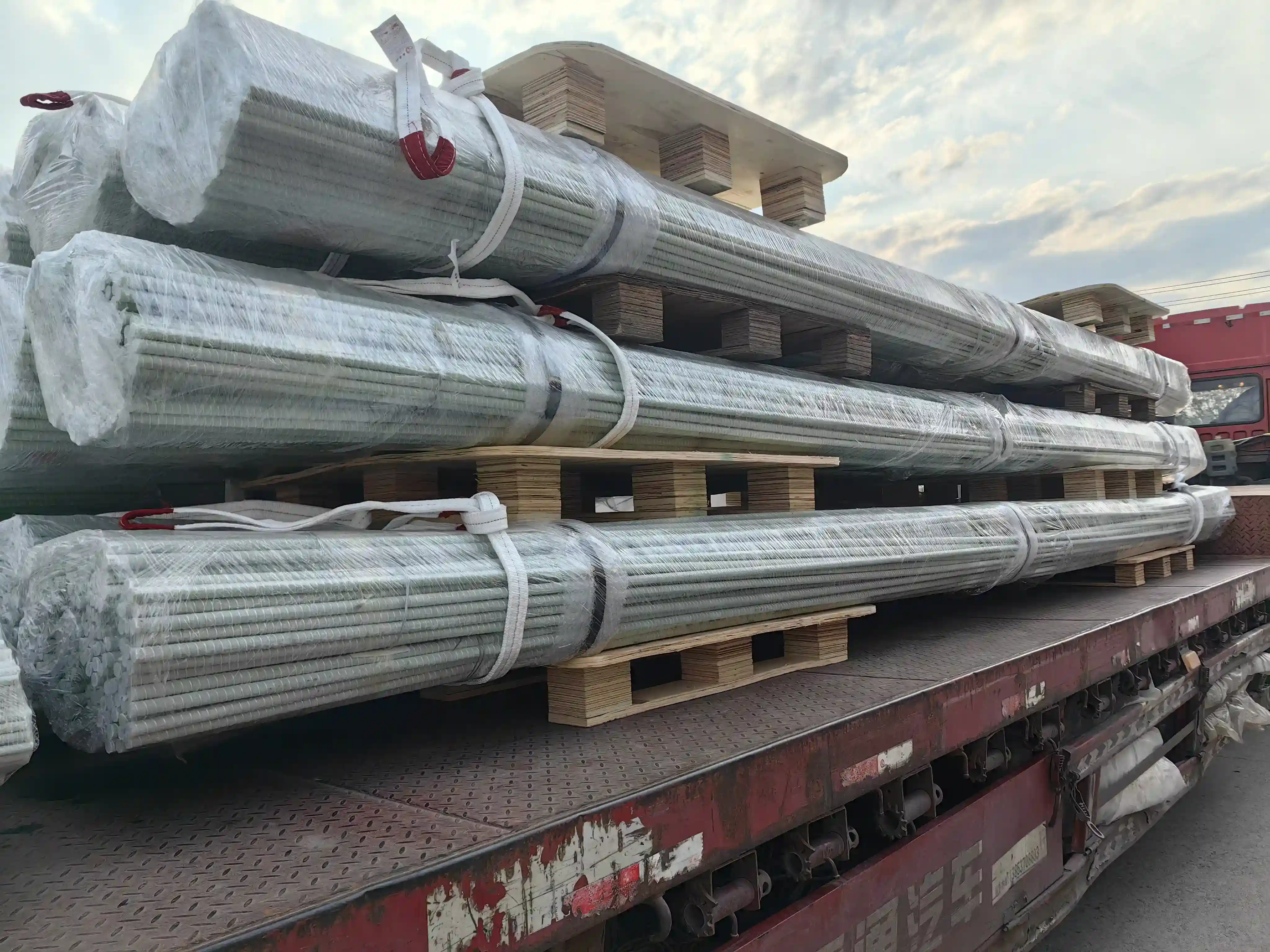
Standard lengths are typically 6 meters (20 feet) or 12 meters (40 feet), though custom lengths can be manufactured on request. Unlike steel rebar, fiberglass rebar can be cut to precise lengths at the factory, reducing on-site waste and labor.
Specialty Shapes and Custom Sizes
In addition to straight bars, fiberglass rebar is available in several custom configurations:
- Bent bars: Pre-bent stirrups, hooks, and L-bars for beam and column reinforcement. Note that fiberglass rebar cannot be bent on-site; all bends must be factory-manufactured.
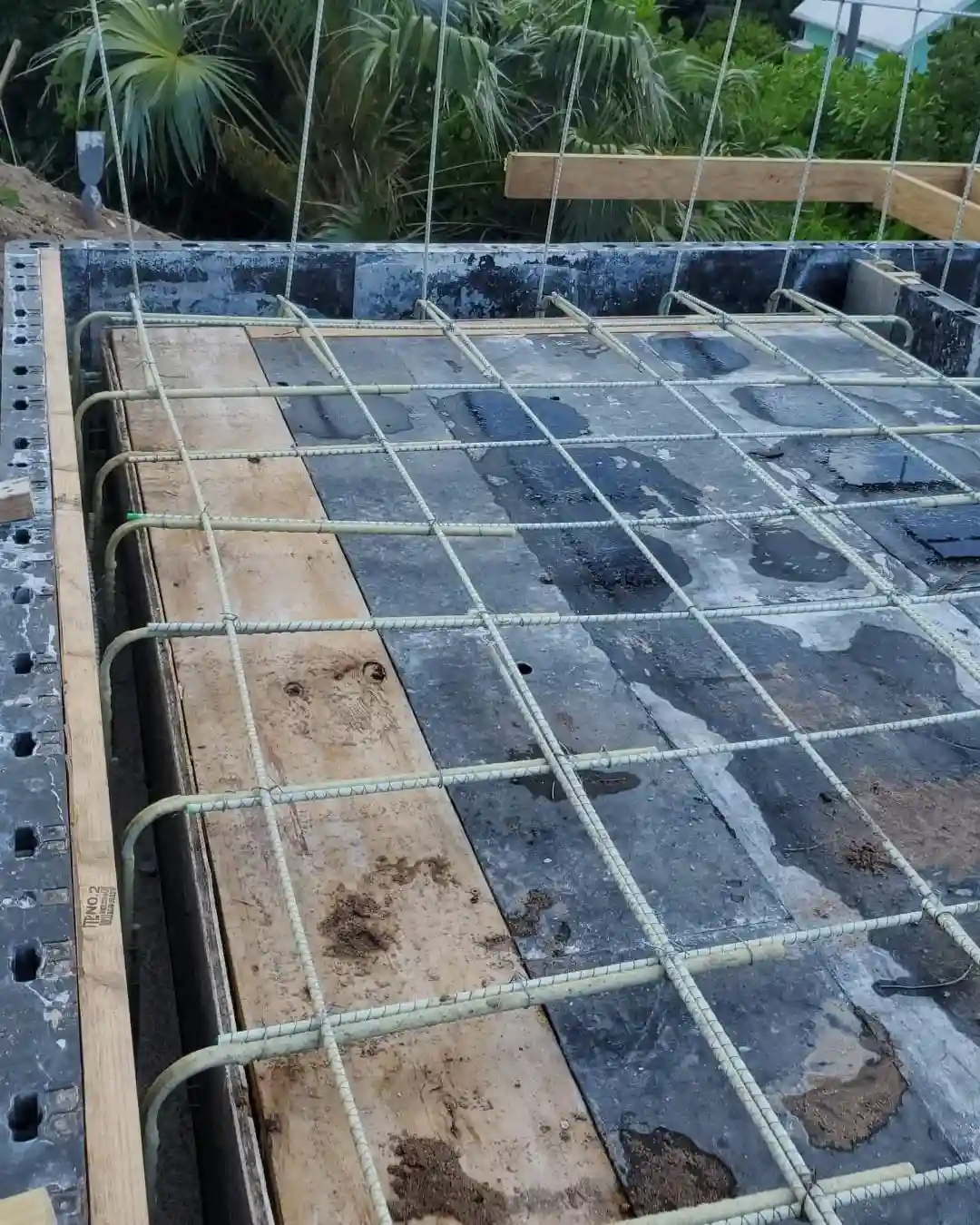
- Grids and meshes: Pre-assembled reinforcement grids for slab and wall applications, reducing on-site tying labor.
- Spirals: Helical reinforcement for piles, piers, and columns.
- Custom lengths: Non-standard cut lengths from 1 meter to 18 meters for specific project requirements.
When selecting fiberglass rebar sizes for a project, it is important to note that the nominal diameter determines the cross-sectional area and therefore the tensile capacity. Design engineers should refer to manufacturer data sheets for exact mechanical properties at each diameter, as these can vary between producers based on fiber content and resin formulation.
Fiberglass Rebar Applications in Construction
The unique combination of corrosion resistance, high tensile strength, and light weight makes fiberglass rebar applications diverse and growing across the construction industry. While steel remains the default choice for standard reinforced concrete, fiberglass rebar has become the material of choice for environments where corrosion poses a serious threat to structural longevity.
Marine and Coastal Construction
Marine environments are among the most aggressive for steel reinforcement. Saltwater spray, tidal cycling, and airborne chlorides rapidly accelerate steel corrosion, often causing concrete spalling within 5-10 years. Fiberglass rebar for marine construction eliminates this problem entirely. Key marine applications include:
- Seawalls and bulkheads: Fiberglass rebar provides long-term corrosion-free reinforcement in intertidal zones where saltwater exposure is constant.
- Docks and piers: Deck slabs, pile caps, and beam elements benefit from non-corrosive reinforcement that withstands decades of marine exposure.
- Coastal protection structures: Revetments, breakwaters, and groynes reinforced with fiberglass rebar require minimal maintenance over their service life.
- Floating structures: The light weight of GFRP reinforcement reduces buoyancy requirements for floating docks and platforms.
Infrastructure Applications
Beyond marine construction, fiberglass rebar is widely used in critical infrastructure where corrosion and durability are primary concerns:
- Bridge decks: De-icing salts penetrate bridge deck surfaces and attack steel reinforcement. Fiberglass rebar bridge deck reinforcement has demonstrated service lives exceeding 75 years in numerous DOT projects across North America.
- Pavement and highway barriers: Concrete pavements and Jersey barriers reinforced with GFRP resist salt damage and require fewer repairs over their service life.
- Tunnel linings: In underground environments with groundwater infiltration, fiberglass rebar prevents corrosion that would otherwise compromise structural integrity.
Chemical and Industrial Facilities
Fiberglass rebar applications extend to chemical plants, wastewater treatment facilities, and industrial floors where exposure to acids, alkalis, and aggressive chemicals would rapidly destroy steel reinforcement. The inert nature of the glass-polymer composite ensures:
- No chemical attack on the reinforcement material
- No staining or discoloration from rust runoff
- Reduced maintenance intervals and lifecycle costs
- Compatibility with waterproofing membranes and chemical-resistant coatings
Specialized Applications
Additional applications that benefit from the unique properties of fiberglass rebar include:
- MRI and medical facilities: Non-magnetic and non-conductive properties eliminate interference with sensitive medical imaging equipment.
- Airport runways and aprons: Non-conductive reinforcement eliminates concerns about static discharge and fuel ignition risks.
- Precast concrete elements: Light weight reduces lifting and handling requirements for precast components.
- Retaining walls and slope stabilization: Long-term corrosion resistance in soil environments with varying pH and moisture conditions.
Fiberglass Rebar Price Guide and Cost Comparison
Understanding fiberglass rebar price is critical for project budgeting and material selection. The cost of fiberglass rebar varies based on diameter, resin type, manufacturing volume, and certification level. While the upfront material cost is typically higher than steel, the total installed cost and lifecycle economics often favor fiberglass rebar in corrosion-prone environments.
How Much Does Fiberglass Rebar Cost Per Meter?
The cost of fiberglass rebar varies by diameter and manufacturer. As a general guideline, current market prices for standard-grade fiberglass rebar range as follows:
| Diameter | Price per Meter (USD) — Approximate | Price per Ton (USD) — Approximate |
|---|---|---|
| 6 mm (#2) | $1.20 - $1.80 | $4,500 - $6,000 |
| 10 mm (#3) | $2.00 - $3.50 | $4,000 - $5,500 |
| 12 mm (#4) | $3.00 - $4.50 | $3,800 - $5,200 |
| 16 mm (#5) | $5.00 - $7.00 | $3,500 - $4,800 |
| 20 mm (#6) | $7.50 - $10.00 | $3,200 - $4,500 |
Note that fiberglass rebar price per meter increases with diameter, but the cost per ton actually decreases for larger bars because the pultrusion process is more efficient at higher throughput rates. For reference, steel rebar typically costs $700-$1,200 per ton, making fiberglass rebar approximately 3-6 times more expensive by weight. However, because fiberglass rebar weighs one-quarter of steel, the cost per linear meter is much closer — approximately 1.5-2.5 times that of steel for equivalent diameter.
Factors Affecting Fiberglass Rebar Price
Several factors influence the final cost of fiberglass rebar:
- Resin type: Vinyl ester resin provides better corrosion resistance than polyester but costs 20-40% more. For most concrete reinforcement applications, vinyl ester is the standard choice due to its superior alkaline resistance.
- Certification level: Products certified to ASTM D7957, ICC-ES, or CE standards command a premium over non-certified alternatives. Certification ensures consistent quality and compliance with building codes.
- Order volume: Bulk orders (10+ tons) typically receive 10-20% volume discounts. Full container loads (20-25 tons) offer the best per-unit pricing.
- Origin and shipping: Fiberglass rebar manufactured in China and Southeast Asia is generally more competitively priced than domestic production, but shipping costs and lead times must be factored in. FOB prices from Chinese ports are typically 15-30% lower than US-manufactured equivalents.
- Custom fabrication: Pre-bent bars, stirrups, and custom lengths add fabrication charges of 10-25% above straight bar pricing.
Total Installed Cost Comparison
When evaluating fiberglass rebar price vs steel rebar, the true comparison must consider total installed cost and lifecycle economics:
- Material cost: Fiberglass rebar costs 1.5-2.5x more per linear meter than equivalent steel.
- Transportation: 75% lighter means significantly lower freight costs — approximately 60-70% savings on shipping.
- Handling and installation: Lighter material reduces crane requirements and labor fatigue. Installation productivity increases by 20-30% with GFRP.
- Maintenance savings: Fiberglass rebar eliminates corrosion-related repairs. For marine structures, this can save $50-$200 per square meter over the structure's lifetime.
- Service life extension: Structures reinforced with fiberglass rebar typically last 75-100 years compared to 25-40 years for steel-reinforced concrete in aggressive environments.
For bridge decks, seawalls, and marine structures, the lifecycle cost of fiberglass rebar is typically 20-40% lower than steel when factoring in reduced maintenance and extended service life.
How to Cut and Install Fiberglass Rebar on Site
Working with fiberglass rebar requires different techniques than steel. Understanding how to cut and install fiberglass rebar on site is essential for ensuring proper reinforcement placement and structural performance. The material behaves differently from steel — it is strong in tension but can be damaged by improper handling.
Cutting Fiberglass Rebar
Unlike steel rebar, which is cut with abrasive saws or bolt cutters, fiberglass rebar requires tools that can cleanly sever the glass fibers without causing delamination or fraying. Approved cutting methods include:
- Abrasive cut-off saw: A standard angle grinder with a masonry or diamond blade works well for clean cuts. Use a guide to ensure square cuts. Always cut in a well-ventilated area and wear a dust mask — the glass dust can irritate skin and lungs.
- Carbide-tipped saw blades: For production cutting, a chop saw with a carbide-tipped blade designed for composites provides faster, cleaner cuts with less dust.
- Diamond wire saw: For large-diameter bars (20mm+), a diamond wire saw delivers the cleanest cut without fraying.
Critical safety note: Never use a torch or heat source to cut fiberglass rebar. The resin matrix will burn, releasing toxic fumes and damaging the structural integrity of the bar. Always use mechanical cutting methods.
After cutting, inspect the ends for fraying or delamination. Any loose fibers at the cut end can be trimmed with sharp shears or ground smooth with sandpaper. Some manufacturers supply pre-cut lengths, which eliminates on-site cutting entirely for standard sizes.
Installation Best Practices
Installing fiberglass rebar follows many of the same principles as steel reinforcement, but with several important differences:
- Tying: Use plastic-coated wire ties or zip ties to secure fiberglass rebar intersections. Standard steel tie wire can abrade the surface coating. Ties should be snug but not overtightened — excessive force can crush the bar surface.
- Chair supports: Use plastic or stainless steel rebar chairs to maintain cover distance. The light weight of fiberglass rebar means fewer supports are needed — typically every 1.2-1.5 meters for horizontal mats.
- Lapping and splices: Development and lap splice lengths for fiberglass rebar are longer than for steel due to the different bond characteristics. Follow ACI 440.11 requirements specifically — do not use steel rebar splice lengths. Typical lap lengths range from 40-60 times the bar diameter.
- Bending: Fiberglass rebar cannot be bent on site. All bends, hooks, and stirrups must be factory-formed during manufacturing. Field bending causes micro-cracking in the resin and reduces tensile capacity by up to 50%.
- Support spacing: Due to the lower modulus of elasticity, support spacing should be closer than for steel to prevent sagging — typically 600-900 mm centers for horizontal reinforcement.
On-Site Handling Tips
- Store fiberglass rebar under cover to prevent UV degradation. While the material has UV-resistant additives, prolonged direct sunlight can weaken the surface resin.
- Use spreader bars or multiple lifting points when moving long bundles to prevent excessive deflection.
- Avoid dropping or throwing bundles — impact damage can create internal cracks that are not visible externally.
- Wear gloves when handling — the surface sand coating can be abrasive on bare skin.
Where to Source Quality Fiberglass Rebar
Knowing where to source quality fiberglass rebar is essential for ensuring your project receives certified, reliable reinforcement material. The global fiberglass rebar market has grown significantly, with established manufacturers in North America, Europe, and Asia supplying projects worldwide.
Key Considerations When Choosing a Supplier
When evaluating fiberglass rebar suppliers for your project — whether for marine construction, bridge decks, or general concrete reinforcement — consider these factors:
- Certification and compliance: Verify that the supplier's products carry relevant certifications such as ASTM D7957, ICC-ES AC454, or CE marking. Request current test reports and certification documents before placing an order.
- Manufacturing quality: Look for ISO 9001-certified manufacturing facilities. Consistent fiber-to-resin ratio, proper cure levels, and accurate dimensional tolerances are hallmarks of quality production.
- Product range: A reputable supplier offers a full range of diameters (6mm to 25mm), standard and custom lengths, and fabricated shapes including stirrups, bent bars, and reinforcement grids.
- Technical support: Quality suppliers provide engineering design assistance, installation guidance, and on-site training for contractor crews. This support is especially valuable for teams new to fiberglass rebar.
- Lead times and logistics: Standard production lead times range from 2-6 weeks depending on order complexity. For large infrastructure projects, plan orders 8-12 weeks in advance to ensure availability.
Global Sourcing Options
Fiberglass rebar is available from multiple global regions, each with distinct advantages:
- North America: Several US-based manufacturers produce ASTM-compliant GFRP rebar. Domestic sourcing offers shorter lead times and easier quality verification but at a higher per-unit cost. Typical pricing: $3.50-$6.00 per meter for 12mm bars.
- China and Southeast Asia: China is the largest producer of glass fibers and fiberglass rebar globally. Chinese manufacturers offer competitive pricing — typically $2.00-$4.00 per meter for 12mm bars FOB Chinese port — with established export experience. Leading Chinese suppliers hold ASTM, CE, and ISO certifications and ship to projects worldwide.
- Europe: European manufacturers focus on CE-marked and ETA-certified products, serving the EU construction market. Pricing is comparable to North American suppliers, with strong technical documentation.
- Middle East: Growing local manufacturing in the UAE and Saudi Arabia serves regional infrastructure and marine projects, with reduced shipping costs for Middle Eastern buyers.
Tips for International Procurement
When sourcing fiberglass rebar internationally, particularly from overseas manufacturers:
- Request samples for independent testing before bulk ordering
- Verify that third-party test reports are current (within 12 months)
- Confirm that the product meets your local building code requirements (ASTM for North America, EN for Europe, etc.)
- Factor in shipping time (4-8 weeks for sea freight from Asia) and customs clearance
- Negotiate Incoterms clearly — FOB, CIF, or DAP delivery terms affect total cost and risk allocation
- Build relationships with vetted suppliers who have demonstrated track records in your application sector
Conclusion
Fiberglass rebar represents a significant advancement in concrete reinforcement technology, offering engineers and contractors a corrosion-proof alternative to traditional steel reinforcement. With its exceptional tensile strength, light weight, chemical inertness, and non-conductive properties, it has become the preferred reinforcement solution for marine structures, bridge decks, chemical plants, and infrastructure projects requiring long-term durability.
When evaluating fiberglass rebar for your project, consider not only the upfront material cost but the total lifecycle value. The higher initial investment is typically offset by reduced transportation costs (75% lighter than steel), faster installation, elimination of corrosion-related maintenance, and extended structural service life — often 75-100 years compared to 25-40 years for steel in aggressive environments.
To summarize the key takeaways from this guide:
- Properties: Fiberglass rebar offers 2-3x the tensile strength of steel, weighs one-quarter as much, and is completely immune to corrosion.
- Standards: Ensure compliance with ASTM D7957, ACI 440.11, or relevant local codes. Certified products from reputable manufacturers guarantee consistent quality.
- Sizes: Available in diameters from 6mm to 25mm, with custom lengths and pre-fabricated shapes. All bending must be done at the factory.
- Applications: Ideal for marine, coastal, infrastructure, chemical, and any environment where steel corrosion is a concern.
- Price: Expect to pay $2.00-$6.00 per meter for standard diameters, with significant discounts for bulk orders. Lifecycle cost is typically 20-40% lower than steel in corrosive environments.
- Sourcing: Choose certified suppliers with proven track records, request current test reports, and plan orders 4-12 weeks ahead depending on project size.
For specific project requirements or technical questions about fiberglass rebar properties, sizing, pricing, or installation, consult with experienced manufacturers and structural engineers who specialize in GFRP reinforcement design. The growing body of field experience and established code provisions make fiberglass rebar an increasingly accessible and reliable choice for modern construction worldwide.