Introduction: GFRP Rebar Bridge Deck Applications
A GFRP rebar bridge deck represents a modern engineering approach to concrete reinforcement in bridge construction. Glass Fiber Reinforced Polymer (GFRP) rebar is a composite material made from high-strength glass fibers embedded in a vinyl ester or epoxy resin matrix. Unlike traditional steel reinforcement, GFRP rebar is inherently corrosion-resistant, non-conductive, and offers exceptional tensile strength while weighing only one-quarter of steel.
In bridge deck construction, GFRP rebar is primarily used as internal reinforcement for concrete decks exposed to de-icing salts, marine environments, and freeze-thaw cycles. The material eliminates the primary failure mechanism of steel-reinforced bridge decks — chloride-induced corrosion — which costs transportation agencies billions annually in repairs and premature replacements. Engineers specify GFRP rebar bridge deck reinforcement for new bridge construction, deck replacements, and rehabilitation projects where long-term durability and reduced maintenance are critical requirements.
This comprehensive guide covers the complete scope of using GFRP rebar in bridge decks: design methodologies following international standards, field-tested construction practices, cost-benefit analysis for procurement decisions, and documented service life data from real installations. Whether you are a consulting engineer preparing a GFRP rebar bridge deck design, a contractor evaluating construction methods, or a procurement specialist comparing material costs, this article provides the engineering information you need.
Why Use GFRP Rebar for Bridge Decks Instead of Steel?
The decision to specify GFRP rebar over conventional steel reinforcement in bridge decks is driven by five decisive engineering advantages that directly address the most common durability challenges in bridge infrastructure.
Corrosion Resistance Eliminates Deck Deterioration
Steel reinforcement in bridge decks corrodes when chlorides from de-icing salts penetrate the concrete cover. The resulting rust expands up to six times the volume of the original steel, creating internal tensile stresses that crack and spall the concrete. GFRP rebar is completely immune to electrochemical corrosion — the glass fibers and polymer matrix do not react with chlorides, moisture, or carbonation. This eliminates the primary cause of bridge deck deterioration and extends service intervals from 15–20 years (with steel) to 75–100 years.
Lightweight Material Reduces Structural Demands
GFRP rebar weighs approximately 1.9 kg/m³ compared to 7.8 kg/m³ for steel — a 75% weight reduction. For a typical bridge deck, this translates to several tonnes less dead load on the supporting structure. Engineers can design longer spans, reduce girder sizes, or increase live load capacity with the same substructure.
High Tensile Strength with Elastic Behavior
GFRP rebar exhibits tensile strength of 700–1,200 MPa, comparable to or exceeding Grade 60 steel (420 MPa yield). The stress-strain curve is linear-elastic until failure, with no yielding plateau. This characteristic requires different design approaches but allows engineers to precisely predict structural behavior under service loads.
Non-Conductive and Non-Magnetic Properties
For bridge decks carrying sensitive instrumentation, railways with signaling systems, or electrical infrastructure, GFRP rebar provides electrical neutrality. It does not interfere with magnetic fields, making it ideal for bridge-mounted sensors and monitoring equipment.
Lifecycle Cost Advantage
Although the initial material cost of GFRP rebar is higher than steel, the total lifecycle cost is significantly lower when accounting for maintenance, repairs, traffic disruption, and early replacement. Numerous state DOT lifecycle analyses show 20–40% total cost savings over 75-year design horizons.
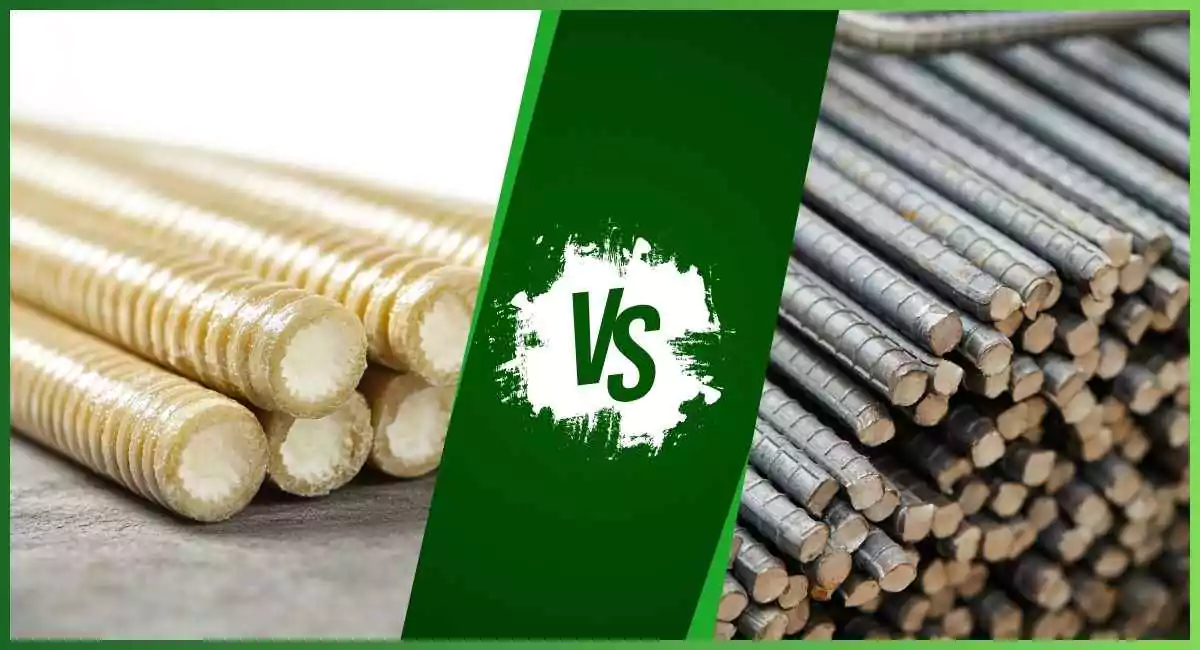
| Property | Steel Rebar | GFRP Rebar |
|---|---|---|
| Tensile Strength | 420 MPa (yield) | 700–1,200 MPa (ultimate) |
| Density | 7,850 kg/m³ | 1,900–2,100 kg/m³ |
| Corrosion Resistance | Poor (requires cover) | Excellent (immune) |
| Modulus of Elasticity | 200 GPa | 40–60 GPa |
| Design Service Life | 15–40 years (corrosion-limited) | 75–100 years (durability-limited) |
GFRP Rebar Bridge Deck Design: Standards and Guidelines
Designing a bridge deck with GFRP rebar requires adherence to established design codes and a thorough understanding of the material’s unique mechanical behavior. Unlike steel, GFRP does not yield, so serviceability limit states often govern the design rather than ultimate strength.
Applicable Design Standards
The primary design references for GFRP rebar bridge deck design include:
- ACI 440.1R-15 — Guide for the Design and Construction of Structural Concrete Reinforced with FRP Bars (USA)
- AASHTO LRFD Bridge Design Guide for GFRP Reinforcement — Specific to bridge deck applications
- CSA S806-12 — Canadian Standards Association code for FRP-reinforced concrete
- CSA S6-19 — Canadian Highway Bridge Design Code, Section 16 (FRP reinforcement)
- fib Bulletin 40 — International Federation for Structural Concrete guidelines
These codes provide the GFRP rebar bridge deck design guide for calculating flexural capacity, crack control, deflection, and development length.
Key Design Parameters
1. Flexural Design: GFRP-reinforced bridge decks are designed using a stress-strain compatibility approach. The linear-elastic behavior of GFRP means that concrete crushing (strain limit εcu = 0.003) typically governs the ultimate limit state rather than rebar rupture. The nominal moment capacity is calculated with a strength reduction factor (φ) of 0.55–0.65, depending on the governing failure mode and code jurisdiction.
2. Crack Control: Because GFRP has a lower modulus of elasticity (40–60 GPa) than steel (200 GPa), crack widths under service loads are wider for the same reinforcement ratio. Designers must increase the reinforcement ratio or use smaller-diameter bars at closer spacing to meet crack width limits of 0.5–0.7 mm for bridge decks per AASHTO.
3. Deflection Control: The lower elastic modulus also leads to higher deflections. The gross moment of inertia (Ig) must be modified using the effective moment of inertia (Ie) per ACI 440.1R, which accounts for tension stiffening of the GFRP-reinforced concrete section. Bridge deck span-to-depth ratios are typically limited to 20–25 for GFRP versus 25–30 for steel.
4. Development Length: Bond characteristics differ from steel. The development length for GFRP bars is calculated based on bar diameter, concrete strength, cover thickness, and confinement conditions. Typical development lengths are 40–60 times the bar diameter, compared to 20–30 diameters for steel.
5. Minimum Reinforcement: Codes require minimum GFRP reinforcement to prevent sudden failure if the concrete cracks. The minimum ratio is based on the cracking moment of the section, typically 1.2–1.4 times the cracking moment, depending on the governing code.
Design Example: Typical Bridge Deck Section
A standard 225 mm thick bridge deck spanning 2.4 m between girders would require GFRP reinforcement in the top and bottom mats. Using #5 (15.9 mm) GFRP bars at 150 mm spacing in the bottom transverse direction and #4 (12.7 mm) bars at 200 mm spacing in the top longitudinal direction satisfies typical strength and serviceability requirements. The clear cover is specified at 50 mm instead of the 65 mm typically required for steel, because corrosion is not a concern — allowing a thinner, lighter deck section.
GFRP Rebar Bridge Deck Construction Process
The construction process for a GFRP rebar bridge deck follows similar sequencing to conventional steel-reinforced decks, but with important material-specific handling requirements that contractors must understand to ensure proper installation and structural performance.
Material Receiving and Storage
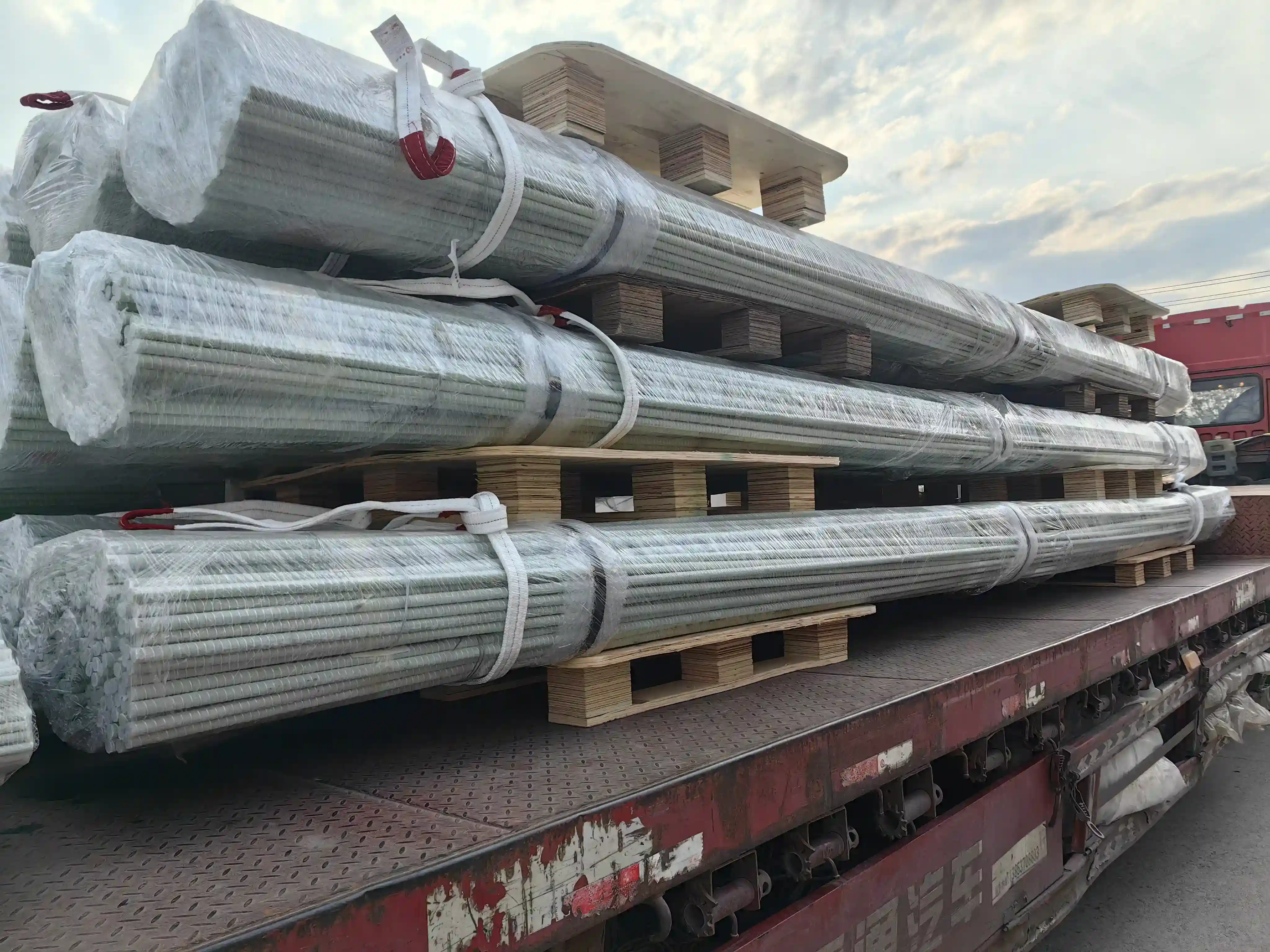
GFRP rebar arrives on site in coils or straight lengths, depending on bar diameter and project specifications. Bars should be stored on level racks at least 100 mm off the ground, covered with opaque UV-blocking tarpaulins. Although GFRP has good UV resistance for short-term exposure, prolonged direct sunlight can degrade the resin matrix surface. Industry guidance limits unshielded outdoor storage to 60–90 days. Each bundle is tagged with lot number, bar diameter, tensile strength, and manufacturer certification for quality traceability.
Cutting and Bending
GFRP rebar cannot be field-bent like steel. All bends and hooks must be prefabricated at the factory using heat-formed processes. On site, bars are cut using an abrasive chop saw or diamond-blade wet saw — never with bolt cutters or shears, which cause splintering. Workers should wear gloves and eye protection because glass fiber dust and splinters can irritate skin and eyes. Cutting produces fine glass particles, so wet cutting is recommended to control airborne dust.
Placement and Tying
GFRP rebar is tied using plastic-coated steel tie wire or all-plastic zip ties. Standard steel tie wire can damage the polymer surface. The lighter weight of GFRP (one-quarter that of steel) makes handling and positioning significantly easier — a single worker can carry and position bars that would require two workers in steel. Support chairs should have wide saddles (minimum 25 mm wide) to prevent localized stress concentrations on the bars. Rebar spacers are typically placed at 600–900 mm intervals, closer than steel, to minimize sagging due to the lower stiffness of GFRP.
Overlap Splices
Lap splices for GFRP rebar are longer than for steel because of the different bond characteristics. Typical lap lengths range from 40 to 60 bar diameters, depending on bar size, concrete strength, and cover. The design drawings must clearly indicate splice locations and lengths. Staggering splices in adjacent bars is critical to maintain structural integrity.
Concrete Placement
Concrete placement follows standard bridge deck procedures, but drop heights should be limited to 1.5 m maximum to avoid displacing the lightweight GFRP bars. Internal vibrators should not contact the GFRP reinforcement directly — maintain a 25 mm clearance. The concrete mix design should have a maximum aggregate size of 20 mm to ensure proper flow through the reinforcement grid. Self-consolidating concrete (SCC) is often preferred for GFRP-reinforced decks because it flows easily through tighter bar spacing without vibration.
Inspection and Quality Control
QA/QC inspection for GFRP bridge deck installation includes verifying bar spacing, cover depth, lap splice lengths, and tie spacing before concrete placement. Cover depth is especially critical because GFRP does not require the same sacrificial cover as steel for corrosion protection, but adequate cover is still needed for bond strength and fire resistance. Non-destructive testing (GPR) can locate GFRP bars in hardened concrete, though the signal interpretation differs from steel because GFRP does not produce a strong reflective signal.
GFRP Rebar Bridge Deck Cost Analysis
One of the most frequently asked engineering procurement questions is: how much does GFRP rebar cost for bridge deck projects? The answer requires a clear distinction between upfront material price and total lifecycle cost.
Material Cost Comparison
The unit price of GFRP rebar is typically 1.5–3 times that of standard epoxy-coated steel rebar on a per-kilogram basis. However, because GFRP weighs 75% less, the cost per linear meter is much closer. For example, a #5 (15.9 mm) GFRP bar delivers equivalent tensile force to a #5 steel bar (420 MPa yield vs 700–1,200 MPa ultimate), but the GFRP bar weighs only 0.37 kg/m versus 1.55 kg/m for steel. On a strength-equivalent basis, the material cost premium for GFRP ranges from 10–40% depending on bar size and quantity.
Installation Cost Savings
GFRP rebar bridge deck construction delivers measurable installation cost reductions:
- Labor: Lighter bars reduce crew size requirements and worker fatigue. Field reports indicate 20–30% faster installation compared to steel
- Handling equipment: No crane required for moving bar bundles — forklift or manual handling suffices
- Reduced cover: Since corrosion is not a concern, concrete cover can be reduced from 65 mm to 40–50 mm, saving 15–25 mm of concrete thickness across the entire deck — a significant volume savings
- No epoxy coating: Eliminates the cost premium and handling care required for epoxy-coated steel
- Lower transportation cost: Smaller truckload weight means more material per shipment
Total Lifecycle Cost Analysis
When evaluating GFRP rebar bridge deck cost for procurement decisions, engineers must factor in the full lifecycle:
| Cost Category | Steel Reinforcement | GFRP Reinforcement |
|---|---|---|
| Initial material cost | Baseline | +10–40% |
| Installation labor | Baseline | −20–30% |
| Concrete volume | Baseline (65 mm cover) | −5–10% (50 mm cover) |
| Maintenance (50 yr) | $200–500/m² (deck repairs) | Near zero (no corrosion) |
| User delay costs (50 yr) | Significant (lane closures) | Minimal |
| Total lifecycle cost | Baseline | −20–40% |
State departments of transportation in Ohio, California, and Texas have published lifecycle cost analyses showing that GFRP-reinforced bridge decks achieve break-even compared to steel within 10–15 years, after which the savings from avoided maintenance accrue directly to the agency. For bridge deck projects in aggressive environments (coastal, heavy de-icing), the break-even period can be as short as 5–8 years.
Volume Discounts and Procurement Tips
For large bridge projects requiring 50+ tonnes of GFRP rebar, expect 15–25% volume discounts from manufacturers. Bundling procurement across multiple bridge decks in a capital program yields further savings. When issuing tenders, specify performance-based requirements rather than prescriptive steel-equivalent specifications to allow GFRP suppliers to optimize bar sizing and spacing.
Lifespan of GFRP Rebar in Bridge Deck Applications
The lifespan of GFRP rebar in bridge deck applications is one of the most compelling reasons for its specification. The question is not whether the GFRP will last — it is whether the concrete deck itself will last as long as the reinforcement.
Expected Service Life
Accelerated aging tests and field data from installations dating back to the mid-1990s indicate a service life exceeding 75 years for GFRP rebar in bridge deck environments, with many manufacturers warranting 100-year design life under normal exposure conditions. By contrast, steel-reinforced bridge decks in cold climates typically require significant repairs at 15–25 years and full deck replacement at 30–50 years.
Environmental Durability Factors
GFRP rebar maintains its mechanical properties across the full range of bridge deck exposure conditions:
- Moisture: The vinyl ester resin matrix absorbs less than 0.5% moisture by weight. Tensile strength retention after 10,000 hours of water immersion at 60°C exceeds 85%
- Alkaline environment: Concrete pore water has pH 12.5–13.5. GFRP bars manufactured with vinyl ester resin retain over 90% of tensile strength after accelerated alkaline conditioning simulating 100 years of exposure
- Freeze-thaw cycling: GFRP is unaffected by freeze-thaw cycles because the polymer matrix is impermeable and does not absorb water that could expand upon freezing
- De-icing salts: Chlorides, magnesium chloride, and calcium chloride have no chemical effect on GFRP materials
- UV radiation: For bridge decks, the reinforcement is fully embedded in concrete, so UV exposure is not a factor once the concrete is placed
Long-Term Mechanical Performance
Long-term creep rupture and fatigue testing demonstrate that GFRP rebar retains 70–85% of its short-term tensile strength over 100-year design life under sustained service loads. Fatigue performance is excellent — GFRP bars subjected to 2 million cycles at 30% of ultimate strength show negligible strength degradation, making them well-suited for bridge decks that experience repeated traffic loading.
Field Validation Data
More than 200 bridge decks in North America have been constructed with GFRP reinforcement since the first demonstration project on the Magog Bridge in Quebec (1996). Core samples taken from decks after 10–20 years of service show no reduction in bar tensile strength, no evidence of chemical degradation, and intact fiber-resin interface. The longest continuously monitored GFRP-reinforced bridge deck is the Joffre Bridge in Quebec (1999), which after 25+ years of heavy de-icing salt exposure shows zero reinforcement-related distress.
This field performance data confirms that the design service life of 75–100 years for GFRP rebar bridge decks is conservative and achievable with proper material quality and construction practices.
Real-World GFRP Rebar Bridge Deck Case Studies
Real-world GFRP rebar bridge deck case studies provide compelling evidence of performance and cost-effectiveness. Here are three representative projects that span different climates, bridge types, and construction approaches.
Case Study 1: Joffre Bridge, Quebec, Canada (1999–Present)
The Joffre Bridge on Route 116 over the Saint-François River was the first North American highway bridge with a GFRP-reinforced concrete deck. The 150 m long, 14 m wide deck used 20 tonnes of GFRP rebar as the primary transverse and longitudinal reinforcement. After 25+ years of harsh Canadian winters with heavy de-icing salt application, the deck shows no corrosion, no spalling, and no cracking attributable to reinforcement. Inspections in 2022 confirmed that the GFRP bars retained full tensile strength. This project set the benchmark for GFRP bridge deck adoption worldwide.
Case Study 2: Ohio DOT Bridge Deck Replacement, USA (2008)
The Ohio Department of Transportation replaced a deteriorated steel-reinforced deck on a three-span continuous steel girder bridge carrying US-24. The new 200 mm thick deck used #5 GFRP bars at 150 mm spacing in the bottom mat and #4 bars at 200 mm in the top mat. The project team reported 25% faster installation compared to the identical steel-reinforced deck on the adjacent span. After 16 years of service, the GFRP deck requires no maintenance while the steel-reinforced span on the same bridge has undergone two patch repairs. ODOT has since adopted GFRP as a standard alternative for bridge deck reinforcement in corrosive environments.
Case Study 3: Coastal Highway Bridge, Florida (2017)
A 240 m long bridge on Florida’s Gulf Coast was constructed entirely with GFRP rebar in the deck, barriers, and approach slabs. The marine environment, with direct salt spray and high humidity, made corrosion-resistant reinforcement essential. Engineers specified GFRP for the entire bridge deck using AASHTO LRFD design guidelines. The 75 mm reduction in concrete cover (from 115 mm to 40 mm) saved 180 m³ of concrete across the deck. Total estimated lifecycle savings: $2.3 million over 75 years versus an epoxy-coated steel alternative.
International Case Studies
Beyond North America, GFRP bridge deck projects in Japan, Europe, and the Middle East further validate the technology. Japan’s Honshu-Shikoku Bridge Authority has used GFRP rebar in more than 30 bridge decks since 2001. In Norway, GFRP-reinforced bridge decks on coastal highways have performed without maintenance for over 15 years in the most aggressive marine environment in Europe.
These GFRP rebar bridge deck case studies consistently demonstrate three outcomes: elimination of corrosion-related deterioration, faster construction schedules, and lower total ownership cost over the design life of the bridge.
Where to Source GFRP Rebar for Your Bridge Project
Sourcing high-quality GFRP rebar for bridge deck projects requires evaluation of manufacturer qualifications, material certifications, and supply chain capabilities. Bridge infrastructure demands the highest quality standards, and not all GFRP products meet the stringent requirements of bridge design codes.
What to Look for in a GFRP Supplier
- Code compliance certification: Verify that the manufacturer’s products are certified to ICC-ES AC454 (USA) or CSA Z807 (Canada), confirming compliance with ACI 440 and AASHTO standards
- Third-party testing: Independent laboratory verification of tensile strength, modulus, bond strength, and durability per ASTM D7205, ASTM D7913, and ACI 440.3R
- Quality management: ISO 9001:2015 certified manufacturing with traceability from fiber to finished bar
- Project references: Demonstrated experience supplying bridge deck projects of similar scale and complexity
- Lead time capability: GFRP rebar is typically manufactured to order with 4–8 week lead times for standard sizes. Large bridge projects require planning procurement well in advance
Standard Product Range for Bridge Decks
Typical GFRP rebar sizes specified for bridge deck reinforcement include #3 (9.5 mm) through #8 (25.4 mm) in standard lengths of 6 m, 12 m, or custom cut lengths. Surface treatment options include sand-coated, helically wrapped, or ribbed deformations for bond enhancement. For bridge deck applications, sand-coated or ribbed bars with minimum bond strength of 12 MPa per ACI 440 are recommended.
CFRP Rebar Solutions — Your Partner for Bridge Deck Projects
At GFRP Rebar Solutions (gfrprods.com), we supply ICC-ES certified GFRP rebar specifically engineered for bridge deck construction. Our product range includes all standard sizes with full mechanical property certifications, project-specific bar cutting and bending services, and technical support for design and installation. Contact our engineering team for project-specific pricing, lead times, and design assistance.
Conclusion
GFRP rebar has transformed bridge deck engineering by providing a corrosion-proof, lightweight, and durable reinforcement solution that outperforms steel across the full lifecycle of the structure. For engineers, the GFRP rebar bridge deck design process is well-supported by international codes (ACI 440, CSA S806, AASHTO), enabling confident specification. For contractors, the lighter weight and simplified handling translate to faster construction with reduced labor costs. For asset owners, the elimination of corrosion-related maintenance delivers substantial long-term savings and extended service life exceeding 75 years.
Key takeaways for engineering procurement:
- Design: Follow ACI 440.1R or AASHTO bridge design guide; serviceability limit states (crack control, deflection) typically govern
- Construction: Factory-fabricate bends, use wet cutting methods, maintain 25 mm vibrator clearance, specify SCC for congestion
- Cost: Higher material price is offset by 20–30% installation savings and 20–40% lifecycle cost reduction
- Lifespan: 75–100 year design life validated by 25+ years of field performance in North America
- Sourcing: Specify ICC-ES certified material with independent test verification for bridge projects
As bridge infrastructure ages and the need for durable, low-maintenance solutions grows, GFRP rebar is no longer a specialist alternative — it is a mainstream engineering material with proven performance. For your next bridge deck project, evaluate GFRP rebar bridge deck construction with the technical guidance provided in this article, and consult with certified suppliers to develop a cost-effective, long-term reinforcement strategy.
Contact GFRP Rebar Solutions today for a project consultation and quotation.